
Celestial Mural in Architectural Setting
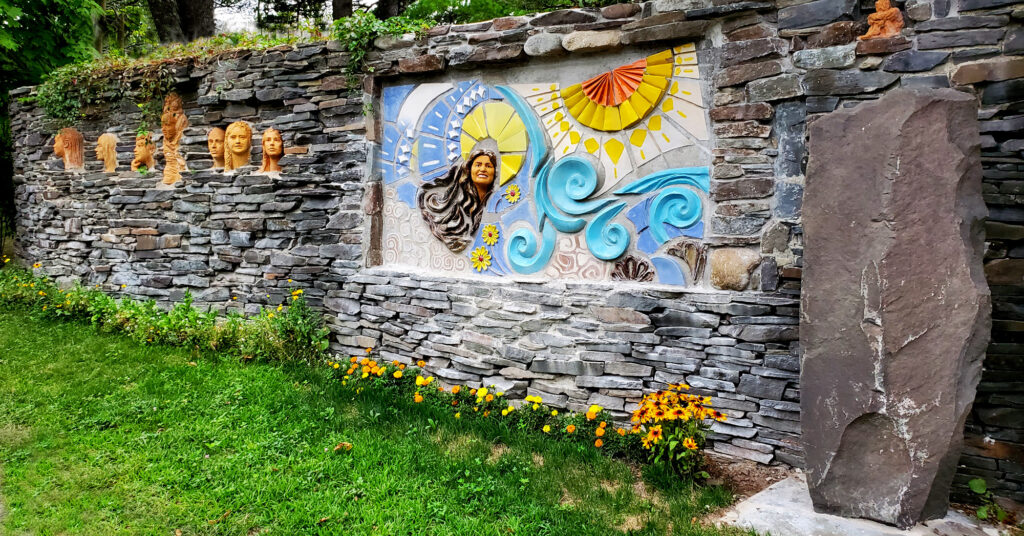
The completed mural is installed within a handcrafted Catskill bluestone wall that combines architectural masonry, portrait sculpture, and ceramic relief elements. Designed as part of a larger environmental artwork, the mural interacts with the surrounding landscape while celebrating light, water, flowers, and the natural rhythms that inspired its creation.
Celestial Mural Construction and Installation Process
Constructing a large-scale ceramic mural is always an adventure. No matter how carefully a project is planned, one never knows exactly what challenges will arise along the way. Ceramic materials are complex, and even clay bodies that appear similar on paper can perform very differently over time.
One of the greatest challenges in architectural ceramics is creating artwork that can survive outdoors through decades of changing weather. Clay body formulas vary greatly, and even the chemical composition of raw materials can change as mines are exhausted and new sources are developed. The stoneware clay body used in my current architectural murals has proven itself to be frost resistant over many years, largely because the source materials have remained consistent over time.
The Celestial Mural was not the first ceramic installation placed in this Catskill bluestone wall. An earlier mural occupied the site, but unfortunately it did not survive its first winter. The sculptural clay body used for that work was locally sourced, and its failure came as a complete surprise. The mural suffered severe frost damage and began to spall and fracture.
Current theories regarding frost resistance focus on the microscopic pore structure within fired clay. Water enters these pores and expands when it freezes. If the pore structure allows the freezing water to move and release pressure safely, the ceramic survives. If the pore structure traps that pressure, cracking, spalling, and eventual failure can occur. Whatever the exact mechanism, the earlier mural did not possess the frost resistance required for long-term outdoor exposure.
Before the Celestial Mural could be installed, every remnant of the failed mural had to be removed. Using a compressed-air jackhammer, we carefully chiseled away deteriorated ceramic material and old cement from the wall. Once the previous installation was removed, the underlying cement surface was leveled as much as possible in preparation for the new mural.
The ceramic tiles themselves required considerable planning. This mural was designed as a high-relief architectural sculpture rather than a collection of flat tiles. Even the lower-relief sections were constructed as hollow ceramic blocks. Most tile walls were maintained at approximately 1½ to 2 inches thick, a dimension that has proven suitable for the particular stoneware clay body used in the project.
Controlling wall thickness was essential to successful firing. Every tile was hollowed from the back to reduce mass and provide space for the installation mortar. The larger relief elements were also carefully hollowed to maintain consistent wall thickness throughout the sculpture. The portrait itself was constructed entirely hollow. Had it been solid, the likelihood of cracking or even exploding during bisque firing would have been very high.
Clay may appear completely dry before firing, yet significant amounts of atmospheric moisture remain trapped within the clay structure. Successful firing depends upon many factors, including wall thickness, firing schedules, heating rates, holding times, kiln atmosphere, and the characteristics of the clay body itself. Understanding these relationships was critical throughout the construction of the mural.
For installation, we chose Portland-based cement mortar rather than commercial tile adhesives. Traditional tile adhesives work very well with flat ceramic surfaces, but the Celestial Mural consists of sculptural ceramic blocks with deep relief and irregular forms. Cement mortar could be packed into the hollow backs of the tiles while simultaneously filling voids between the ceramic elements and the wall.
Another advantage was material compatibility. Portland cement is itself considered a ceramic material, making it an ideal companion to fired clay in an architectural installation. Cement, like ceramics, is mineral based and remains stable under outdoor temperature fluctuations. Once cured, the mortar provides a durable, weather-resistant bond suitable for long-term exterior use.
In retrospect, we wished we had used a straight Portland cement and sand mixture rather than a conventional mortar mix. The mortar cured more slowly than expected. A faster-setting Portland cement mixture would have reduced some of the need for temporary support structures during installation.
Mechanical reinforcement was also incorporated throughout the mural. Sleeve anchors were installed into the existing cement wall to secure major elements. The portrait relief received additional reinforcement through the use of a steel dowel that extended completely through the wall and was mechanically fastened from the opposite side. Combined with the mortar bed and anchoring system, these measures ensure that the mural remains securely integrated with the wall structure for the long term.
After the installation was complete and the mortar had fully cured, the entire mural surface was treated with a waterproofing sealer. We brushed on a diluted mixture of GE Silicone Supreme caulking and naphtha, allowing the silicone to penetrate the ceramic surfaces, and mortar joints. This treatment provided an additional layer of water resistance while helping to reduce moisture infiltration into the ceramic and masonry structure during freeze-thaw cycles. As with every stage of the project, the goal was to maximize the long-term durability of the mural while preserving its sculptural character and integration with the surrounding bluestone wall.
The Inspiration Behind the Celestial Mural
The Celestial Mural grew from a simple desire to create something beautiful and lasting for the world.
Located at a busy intersection traveled by visitors on their way to the Catskill Mountains and the historic village of Woodstock, the mural is seen by people from many different places. Most will never meet the artist, and many may only glimpse the work for a moment as they pass by. Yet even a brief encounter with beauty can have value.
The imagery of the mural reflects many of the things that have inspired me throughout my life: flowers, color, the warmth of the sun, flowing water, and the beauty found in nature. At the center of the mural is Laurel, whose presence has inspired much of my work over the years. The portrait is surrounded by celestial forms, flowers, waves, and symbols that celebrate the connection between human life and the natural world.
I have never been interested in creating art for theories or intellectual fashions. My interest has always been in making things. Sometimes those things take the form of flowers, sunlight, flowing water, and images of beauty. But there is another part of ceramic art that has fascinated me throughout my life.
A lump of clay begins as mud. Through imagination, labor, and fire it becomes something entirely different. One of the great joys of sculpture is bringing form and character out of an ordinary material. A face emerges from the clay, takes on a presence of its own, and begins to feel alive. There is a kind of magic in that process that has never lost its wonder for me.
As an artist, the work of my hands is the only lasting gift I can leave behind. Whether I am sculpting flowers, creating architectural murals, or building dragons born from mud and fire, the desire is always the same: to bring something into the world that did not exist before.
My gift is the beauty of the flowers that come from my hands, but also the life that emerges from clay through imagination, craftsmanship, and fire.